
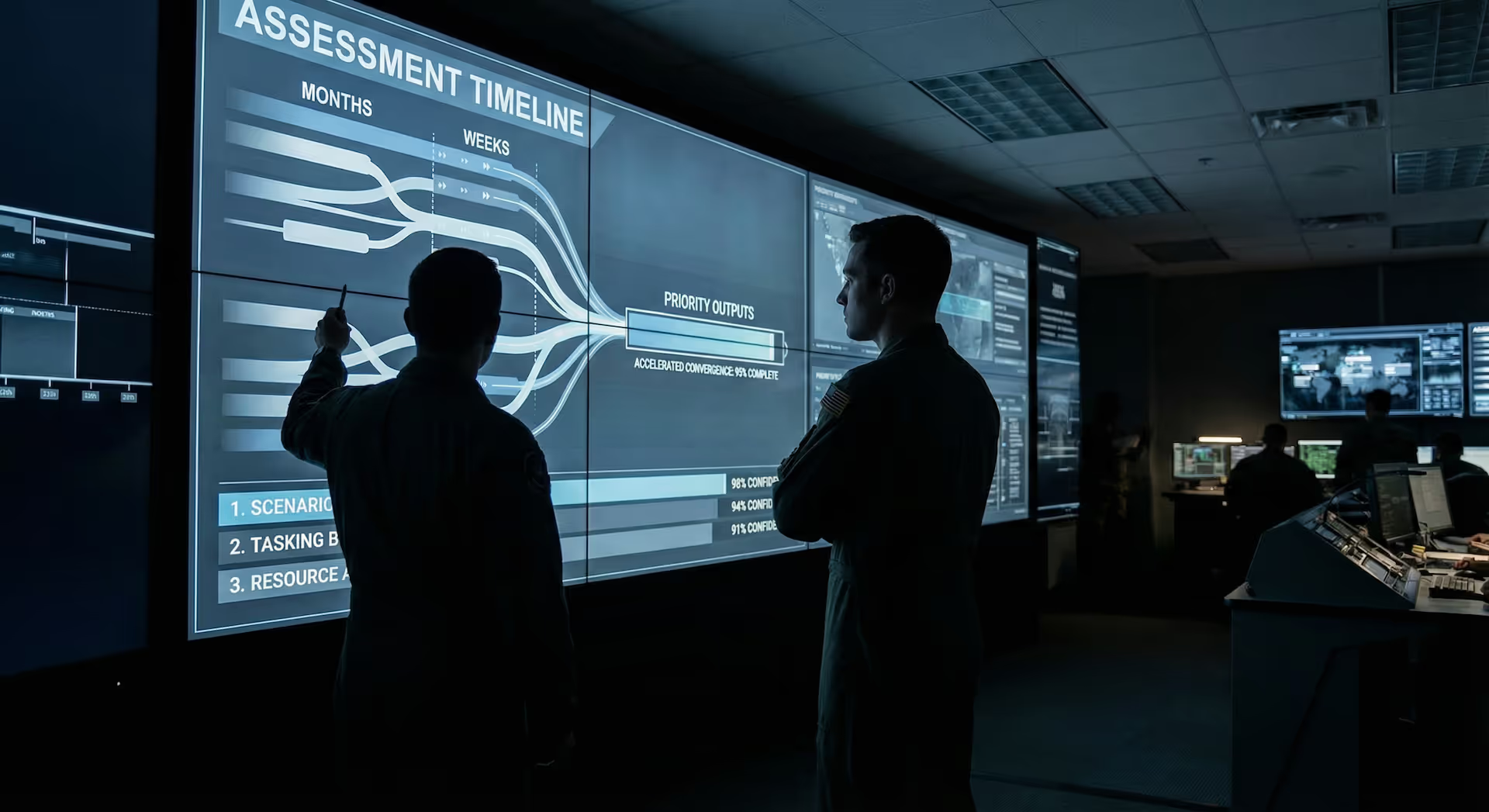
The problem isn't new. The Commander's Handbook for Assessment Planning and Execution has long outlined the mechanics of effects assessment, task assessment, and deficiency analysis. But the process itself, gathering data, synthesizing qualitative and quantitative indicators, developing threshold criteria, and building consensus across stakeholders, remains labor-intensive and sequential. A combatant command's assessment cell can spend months on what should take weeks.
The gap between strategic intent and operational capability is no longer acceptable.
Why Speed Matters Now: The Congressional and Strategic Mandate
The 2026 NDS assumes faster decision-making. The FY 2026 Top DoD Management and Performance Challenges report identifies, "responsive and responsible modernization and procurement"as a critical challenge, with acquisition processes cited as a key friction point. Meanwhile, Congress has explicitly directed the Department to accelerate research, development, test, and evaluation, particularly for counter-UAS technologies and AI-enabled systems.
The FY26 National Defense Authorization Act (NDAA) created new frameworks like the Joint Interagency Task Force 401 to coordinate faster integration of emerging capabilities. But faster integration requires faster assessment. A combatant command cannot field a capability it hasn't rigorously evaluated. The tension is real: rigor takes time, but delay costs relevance.
Consider the operational reality:
- Counter-UAS systems are evolving weekly. A four-month assessment cycle means evaluating yesterday's threat against today's technology.
- AI-enabled targeting systems require continuous validation as models update. Static assessment frameworks can't keep pace with continuous learning systems.
- Autonomous swarms demand real-time performance data across distributed environments. Traditional data collection methods are too slow.
The 2026 NDS explicitly calls for, "decision dominance," in the Indo-Pacific and, "integrated deterrence," across all domains. Neither is possible if assessment timelines lag threat evolution by months.
The Assessment Bottleneck: Where Strategy Meets Reality
Most combatant commands follow a similar assessment workflow:
- Data Gathering Phase (4-6 weeks): Test results, operational feedback, and telemetry are collected from disparate sources, test ranges, field exercises, contractor reports, allied inputs.
- Indicator Development (3-4 weeks): Assessment teams manually develop measures of effectiveness (MOE) and measures of performance (MOP) against doctrine and mission requirements.
- Consensus Building (4-8 weeks): Stakeholders, operations, intelligence, logistics, legal, allied representatives, review findings through sequential gates. Each gate waits for the previous one to close.
- Decision Briefing (2-3 weeks): Results are synthesized into a go/no-go recommendation for the commander.
Total timeline: 13-21 weeks. In a threat environment where adversaries iterate in 4-6 weeks, this is a strategic liability.
The friction points are well-known but rarely addressed
- Data Silos: Test data lives in one system, operational feedback in another, contractor reports in a third. Synthesizing a coherent picture requires manual integration.
- Subjective Indicator Development: MOE and MOP are often developed ad-hoc, making it difficult to compare assessments across capabilities or commands.
- Sequential Oversight: Each stakeholder group reviews findings independently, creating bottlenecks and rework cycles.
- Audit Trail Gaps: When consensus is built through email and spreadsheets, it's difficult to trace how a decision was made or what assumptions drove it.
The Structured Speed Approach: Automation Without Shortcuts
The solution isn't to skip assessment, it's to restructure it. Modern assessment platforms can compress the timeline from months to weeks by automating data collection, standardizing indicator development, and enabling real-time collaboration across distributed teams.
The Workflow Transformation: Frictionless Decision-Making
We don’t replace your workflow—we power it with better data.
By injecting a structured assessment platform into your existing processes, the steps remain the same, but the friction disappears. We move the bottleneck from "gathering data" to "making decisions."
From Sequential Gathering to Continuous Ingestion
Stop waiting for the "data-gathering phase" to end. Azymmetric continuously ingests telemetry, test results, and operational feedback from ranges, exercises, and allied partners. Data is normalized and validated automatically, ensuring your repository is mission-ready before the assessment even begins.
From Manual Metrics to AI-Enhanced Measures
Analysts shouldn't spend weeks building spreadsheets. Our platform generates candidate Measures of Effectiveness (MOE) and Performance (MOP) derived directly from mission objectives and doctrine. By flagging anomalies for human review, we accelerate the creation of the raw material, leaving your team free to apply their expert judgment.
From Fragmented Tools to a Unified Data Environment
Kill the email chains and disconnected spreadsheets. Stakeholders work within a shared, authoritative data environment with full audit trails and role-based access. This ensures every decision-maker—from the J-code staff to the Prime—is referencing the same ground truth in real-time.
From Sequential Gates to Parallel Review
Don't wait for one department to finish before the next begins. Our platform enables parallel review: Operations, Intelligence, Legal, and Logistics can engage with continuously updated findings simultaneously. This accelerates your established review gates without bypassing the necessary rigor.
The Result: Mission Speed
A Combatant Command can move from "Requirement" to "Evidence-Based Risk Assessment" in 4–6 weeks instead of 13–21 weeks.
- Rigor remains.
- Workflow remains.
- Friction disappears.
Risk Quantification: Making Speed Defensible
One concern with accelerated assessment is the perception that speed compromises rigor. It doesn't, if the platform is designed to quantify and communicate risk clearly.
A structured assessment platform should:
- Quantify Confidence Levels: Rather than binary ‘go/no-go,’ assessments should communicate confidence intervals. "We're 85% confident this system meets the threshold, with 15% uncertainty due to limited operational data."
- Flag Assumptions: Every assessment rests on assumptions about threat, environment, and doctrine. A good platform makes these explicit and traceable.
- Enable Incremental Fielding: Instead of ‘field fully’ or ‘don't field,’ platforms should support phased deployment with clear success criteria and rollback options. "Field in limited scope with these success metrics; reassess in 90 days."
- Support Continuous Validation: Assessment doesn't end at fielding. Platforms should enable ongoing performance monitoring, allowing commanders to adjust employment or escalate concerns in real-time.
This approach is aligned with the Joint Force doctrine emphasis on ‘adaptive leadership’ and the 2026 NDS call for, "learning organizations. "Speed and rigor aren't opposites; they're complementary when the right tools are in place.
What This Enables: Operational Advantage
Faster assessment unlocks faster fielding. A combatant command can evaluate acounter-UAS solution in four weeks instead of four months, then make a go/no-go decision with confidence. It can test an AI-enabled targeting system in a controlled environment, assess its performance against doctrine, and recommend integration into operational planning within a decision cycle that matches the pace of threat evolution.
For UK partners and NATO allies, this matters enormously:
- Interoperability at Speed: When the UK, Australia, and European commands can assess and integrate new capabilities at speed, interoperability improves. Shared assessment frameworks mean allied forces can trust each other's evaluations and integrate capabilities faster.
- Procurement Alignment: When assessment timelines align with procurement cycles, waste decreases. A capability that takes six months to evaluate but only three months to procure creates a mismatch. Faster assessment enables faster procurement decisions.
- Doctrine Evolution: When combatant commands can assess new capabilities quickly, they can also evolve doctrine quickly. AI-enabled systems may require new TTPs (Tactics, Techniques, and Procedures). Faster assessment enables faster doctrine development.
- Alliance Confidence: When combatant commands can say, "we evaluated this rigorously, we trust it, we're fielding it," the entire alliance moves faster. Confidence is contagious.
The Platform Imperative: Why Tools Matter
None of this happens without the right infrastructure. Spreadsheets and manual processes can't compress assessment timelines. Siloed data can't enable real-time collaboration. Legacy systems can't keep pace with the velocity of modern threats.
Platforms designed for structured speed should combine:
- AI-Assisted Analysis: Automated indicator development, anomaly detection, and pattern recognition that amplify human judgment without replacing it.
- Continuous Data Integration: Real-time ingestion of telemetry, test results, and operational feedback from multiple sources, with automatic normalization and validation.
- Collaborative Workflows: Role-based access, parallel review cycles, and version control that enable distributed teams to work simultaneously rather than sequentially.
- Audit and Traceability: Complete audit trails that document how decisions were made, what assumptions drove them, and who reviewed them. This is essential for both accountability and learning.
- Interoperability Standards: Platforms should support JADC2 and allied data standards, enabling assessment data to flow seamlessly across commands and partners.
These aren't ‘nice to have’ features. They're the difference between keeping pace with threats and falling behind.
A Pragmatic Path Forward
The 2026 NDS assumes combatant commands can move fast. The question is whether the tools match the ambition. For commands serious about cutting assessments from months to weeks, the answer is clear: structured speed platforms aren't optional. They're the difference between decision dominance and decision lag.
The threat landscape won't wait. Neither should assessment.
%20copy.avif)
%20copy.avif)
%20copy.avif)